

Most of a Japanese card is numbers and symbols that are the same in every language: HP, type, energy costs, damage, weakness, resistance, retreat cost and the collection number on Pokémon cards; cost, power, counter, life and the card number on One Piece cards. To read the text, look the card up by its number. One Piece card numbers are identical in Japanese and English, so the official English card list gives you the translation.
Japanese cards look intimidating the first time you open a pack, but most of what matters on a card is numbers, symbols and codes that are the same in every language. This guide goes through a Japanese Pokémon card and a Japanese One Piece card part by part, shows what you can read without any Japanese, and explains how to find the full text when you need it. The card parts below follow the official rule manuals from Pokémon Japan and Bandai.
What can I read on a Japanese card without knowing Japanese?
More than you'd think. On a Japanese Pokémon card, the HP, the type symbols, the energy symbols on each attack, the damage numbers, weakness, resistance, retreat cost, regulation mark and collection number are all numbers or symbols. On a One Piece card, the cost, power, counter value, life and card number are all numbers. The Japanese text is mainly the card's name, its attack or effect wording, and the flavour text.
If you're collecting rather than playing, that's usually all you need: the artwork, the set and the card number tell you exactly which card you have.
How do I read the top of a Japanese Pokémon card?
Pokémon Japan's rule manual labels these parts on a Pokémon card:
- Name: the Pokémon's name, in Japanese. The artwork usually tells you who it is.
- Evolution stage: whether it's a Basic, Stage 1 or Stage 2 Pokémon.
- HP: its hit points. The Pokémon is knocked out when it has taken that much damage.
- Type: the symbol for its type. The manual lists 11 types, and type matters for weakness and resistance.
How do I read the attacks?
Each attack has three parts you can read straight away: the energy symbols on the left show what it costs to use, the name is in the middle, and the number on the right is the damage. The Japanese text under the attack explains any extra effect. That text is the part you'll want to look up if you're playing.
Below the attacks are three more symbol-and-number boxes:
- Weakness: attacks from that type do double damage.
- Resistance: attacks from that type do 20 less damage.
- Retreat cost: how many energy it costs to move this Pokémon from the Active Spot to the Bench.
What do the marks at the bottom of a Pokémon card mean?
| Part | Where | What it tells you |
|---|---|---|
| Regulation mark | Bottom left | A letter used to decide which cards can be used in official events. Cards from the Sun & Moon series onward have one. |
| Expansion mark | Bottom left, next to the regulation mark | Which product the card came from. On cards from XY BREAK and earlier, it's at the bottom right instead. |
| Collection number | Bottom | The card's number in the set and the total number of cards in the set. |
| Rarity mark | Bottom | How rare the card is. Booster pack cards carry one. |
| Illustrator | Bottom | The artist who drew the card. |
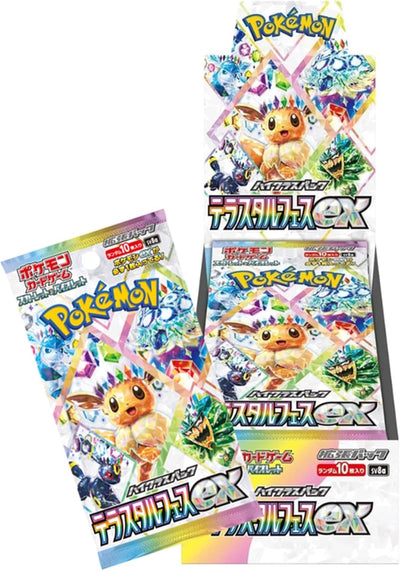
Collectors often know Japanese rarities by their letter codes. Pokémon Japan's own page for Terastal Festival ex, for example, puts its SAR cards front and centre as the set's highlight.
Which regulation marks can be played in Japan right now?
According to the official Pokémon Card Game site in Japan, cards with the regulation mark H, I or J can be used in the Japanese Standard format from 23 January 2026. Other countries publish their own rules and dates, so if you're building a deck for an event outside Japan, check that event's rules.



How do I find the English version of a Japanese Pokémon card?
Use the set and the collection number. Japanese sets are often smaller than English ones, and English sets often combine two Japanese sets, so a card's number in Japanese usually isn't the same as its number in English. Look the card up by its Japanese set first, then find the matching English set. Our guide to Japanese vs English Pokémon cards has a table of which Japanese sets became which English sets.
For the exact Japanese text, Pokémon Japan's official site has a card search.
How do I read a Japanese One Piece card?
One Piece cards are easier, because the card number is the same in Japanese and English. A Japanese card numbered OP14-001 is the same card as the English OP14-001, so you can look up the English text on Bandai's official English card list.
Bandai's rule manual lists these parts:
| Part | On which cards | What it means |
|---|---|---|
| Cost | Character, Event, Stage | How much you pay (in DON!! cards) to play or activate it |
| Power | Leader, Character | Attack strength. In a battle, the higher power wins |
| Counter | Character | The power boost it gives when used during the Counter Step |
| Life | Leader | How many cards go face down in your Life area at the start |
| Colour | All | Your deck can only use colours shown on your Leader |
| Attribute and type | Leader, Character (type also on Event, Stage) | Groups that card effects refer to |
| Card number | All | The set code and number, e.g. OP14-001 |
| Rarity | All | How rare the card is |
| Block symbol | All | A mark printed on every card alongside its number and rarity |
The rarity is printed as a short code. Bandai's English card list uses L for Leader, C for Common, UC for Uncommon, R for Rare, SR for Super Rare and TR for Treasure Rare, and the product pages also list Secret Rares and Special cards.
DON!! cards have no text to read: they pay for your cards and add 1000 power during your turn to the Leader or Character they're attached to. A deck is 50 cards plus 10 DON!!, with no more than 4 copies of the same card number.


To see which English set each Japanese One Piece box matches, read One Piece Card Game Japanese sets and their English names.
Where should I start with Japanese cards?
A few single packs are the cheapest way to see the cards in your hand before you buy a box. Japanese Pokémon packs start at AED 42 for Glory of Team Rocket, with Black Bolt at AED 59 and Shiny Treasure ex at AED 68. Japanese One Piece packs are AED 56 each.


Buying Japanese cards from Brickmak
- Every box and pack is genuine and factory sealed.
- Free delivery across the UAE on orders of AED 150 or more; cash on delivery from AED 50.
- Unopened items can be returned within 14 days, and our courier collects them free.
Shop Japanese Pokémon, Japanese trading cards, One Piece and card sleeves to protect your best pulls.


